main. Related: mcp-api-adapter, custom sources, ClawQL Streams.title: ClawQL Protocol Fabric
ClawQL Protocol Fabric
Status: Shipped (loop proven August 2026)
Depends on: ClawQL Core (search / execute / memory_*) · mcp-api-adapter @0.6+ · mcp-grpc-transport
Smoke: scripts/dev/smoke-protocol-fabric-loop.sh · design notes in protocol-fabric-loop-benchmark.md
One-liner
ClawQL’s Protocol Fabric connects any protocol to any other protocol with MCP as the common intermediate representation.
Not a gateway product name for one port — the bidirectional protocol translation layer formed by Core + mcp-api-adapter.
Architecture diagram
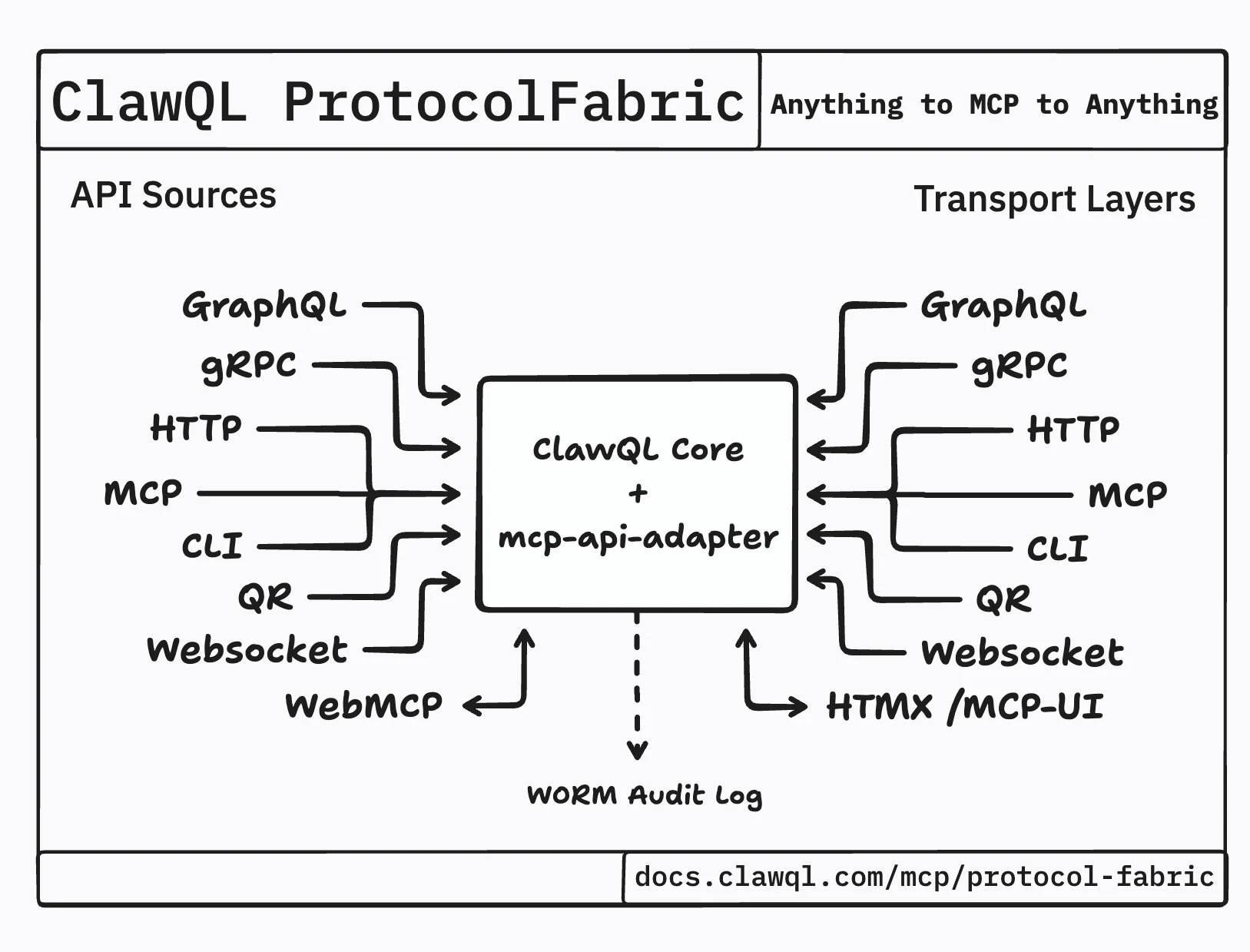
Seven API sources on the left (plus WebMCP (preview) at the bottom-left inbound arrow), ClawQL Core + mcp-api-adapter at the center, seven transport layers on the right. WORM Audit Log below the hub; HTMX / MCP-UI on the bottom-right outbound arrow. Marketing landing: clawql.com/protocol-fabric. Site assets: /images/protocol-fabric/clawql-protocol-fabric.webp (WebP) and .png fallback — kept under /images/ so they do not collide with this docs route at /mcp/protocol-fabric. Repo copies in images/.
Both directions
Any input protocol
  CLI · OpenAPI · GraphQL · gRPC · WebSocket · MCP · WebMCP (preview)
           │
           ▼
    ClawQL Core (→ MCP)
           │
           ▼
      MCP (common IR)
           │
           ▼
  mcp-api-adapter (MCP →)
           │
           ▼
Any output protocol
  CLI · OpenAPI · GraphQL · gRPC · WebSocket · MCP
| Direction | Package | Claim |
|---|---|---|
| Any API → MCP | ClawQL Core | Agents discover and call upstream REST / GraphQL / gRPC / CLI via MCP tools |
| MCP → any API | mcp-api-adapter |
Wrap any MCP server (any language) and expose OpenAPI, GraphQL, /mcp, gRPC, WebSocket, gen-cli |
Together: gRPC service ↔ GraphQL consumer, CLI ↔ REST, OpenAPI ↔ gRPC, WebSocket event ↔ MCP tools — any combination, either direction.
Proven end-to-end loop
In August 2026 we ran a deterministic smoke that crosses both fabric directions in one path and lands a real vault note:
WebSocket event
    → mcp-api-adapter (/ws tools/call)
    → clawql-mcp execute(cli__fabric_event__run)
    → gen-cli subprocess
    → POST /memory_ingest on the adapter (REST)
    → clawql-mcp memory_ingest
    → vault note with marker FABRIC_LOOP_*
    → memory_recall finds the marker
What that proves in plain language:
- WS → MCP — a WebSocket client calls
executethrough the adapter without speaking MCP itself. - MCP → CLI — Core runs a CLI custom source (
cli__fabric_event__run) that shells out to gen-cli. - CLI → REST → MCP — gen-cli POSTs adapter REST
/memory_ingest; the adapter translates that back into the MCPmemory_ingesttool. - Data lands — the vault receives the event marker;
memory_recallreturns it. Smoke exit code 0 onmain.
This is not an LLM benchmark cell. It is a protocol loop: if any hop fails, the marker never shows up in recall.
Topology (recursion-safe)
| Layer | Role |
|---|---|
| A ClawQL MCP | Real tools: execute, memory_ingest, memory_recall, … |
| B mcp-api-adapter | Wraps A — OpenAPI + GraphQL + /mcp + gRPC + WebSocket /ws |
| C gen-cli | Thin CLI generated from B’s catalog; POSTs to B’s REST surface |
| D CLI custom source | sources.json → one op that runs C with memory_ingest baked into cliArgs |
Why this does not recurse: execute spawns gen-cli → REST POST /memory_ingest → adapter CallTool memory_ingest. That path never calls execute again. Do not point gen-cli at an execute of the same CLI op.
WS tools/call execute
        │
        ▼
 clawql execute(cli__fabric_event__run)
        │ spawn
        ▼
 gen-cli memory_ingest --args '{event…}'
        │ POST
        ▼
 adapter /memory_ingest
        │
        ▼
 clawql memory_ingest  ← terminal hop
Run it locally
From the repo root (after npm ci / workspace builds the smoke triggers):
scripts/dev/smoke-protocol-fabric-loop.sh
Pass criteria the script enforces:
- Adapter
/healthzlistswebsocketinsurfaces - Two distinct WS
executecalls returnok: true memory_recallfinds theFABRIC_LOOP_*markers- Exit 0
Default ports: ClawQL MCP 18080, adapter 18090 (overridable via CLAW_PORT / ADAPTER_PORT). The script clears leftover listeners on those ports before starting.
WebSocket message shape
{
  "id": "evt-1",
  "tool": "execute",
  "arguments": {
    "operationId": "cli__fabric_event__run",
    "args": {
      "args": [
        "--args",
        "{\"title\":\"Fabric loop evt-1\",\"insights\":\"marker FABRIC_LOOP_evt-1\",\"tags\":[\"fabric-loop\"],\"append\":true}"
      ]
    }
  }
}
Reply: \{ "id": "evt-1", "ok": true, "result": … \}.
Direct tool: "memory_ingest" over WS is valid but does not prove the CLI custom-source hop — the smoke uses execute for that.
Why “Protocol Fabric” (not two package names)
Marketing and GTM need a single claim. Explaining “Core plus mcp-api-adapter” every time buries the product.
Use: “ClawQL Protocol Fabric — MCP as the connective tissue between protocols.”
Avoid: Calling Core an “OpenAPI gateway” or the adapter “the OpenAPI gateway” without direction — those collide.
Competitive framing
| Alternative | What it does | Gap |
|---|---|---|
| mcpo (Open WebUI) | MCP → OpenAPI only (Python) | One surface, one direction |
| Kong / Apigee | Classic protocol translation | No MCP IR, not agent-native |
| APIAgent / OpenAPI→MCP proxies | APIs → MCP | Inverse of the adapter; not multi-surface outward |
Nobody else ships both directions with MCP as IR and the full multi-surface outward adapter in one product story.
Enterprise Service Buses reduced N×M integrations to N+M via a common bus. Protocol Fabric is the agent-era analogue: MCP is the message format, full protocol surface on both sides.
Language-agnostic
The adapter is implemented in TypeScript (npx mcp-api-adapter). Upstream MCP servers may be Python, Go, Rust, or anything that speaks MCP over stdio, Streamable HTTP, or gRPC. Users do not write TypeScript to use the fabric.
Related docs
- Adapter guide:
mcp-api-adapter.md - Custom sources (CLI ops into Core):
getting-started/custom-sources.md - Streams (event-driven autonomous execution):
streams/clawql-streams.md - GTM positioning:
gtm/protocol-fabric.md - Loop design / non-goals:
design/protocol-fabric-loop-benchmark.md